
 Dogs
Dogs Cats
Cats Birds
Birds Horses
 On the Land
 In the Sea
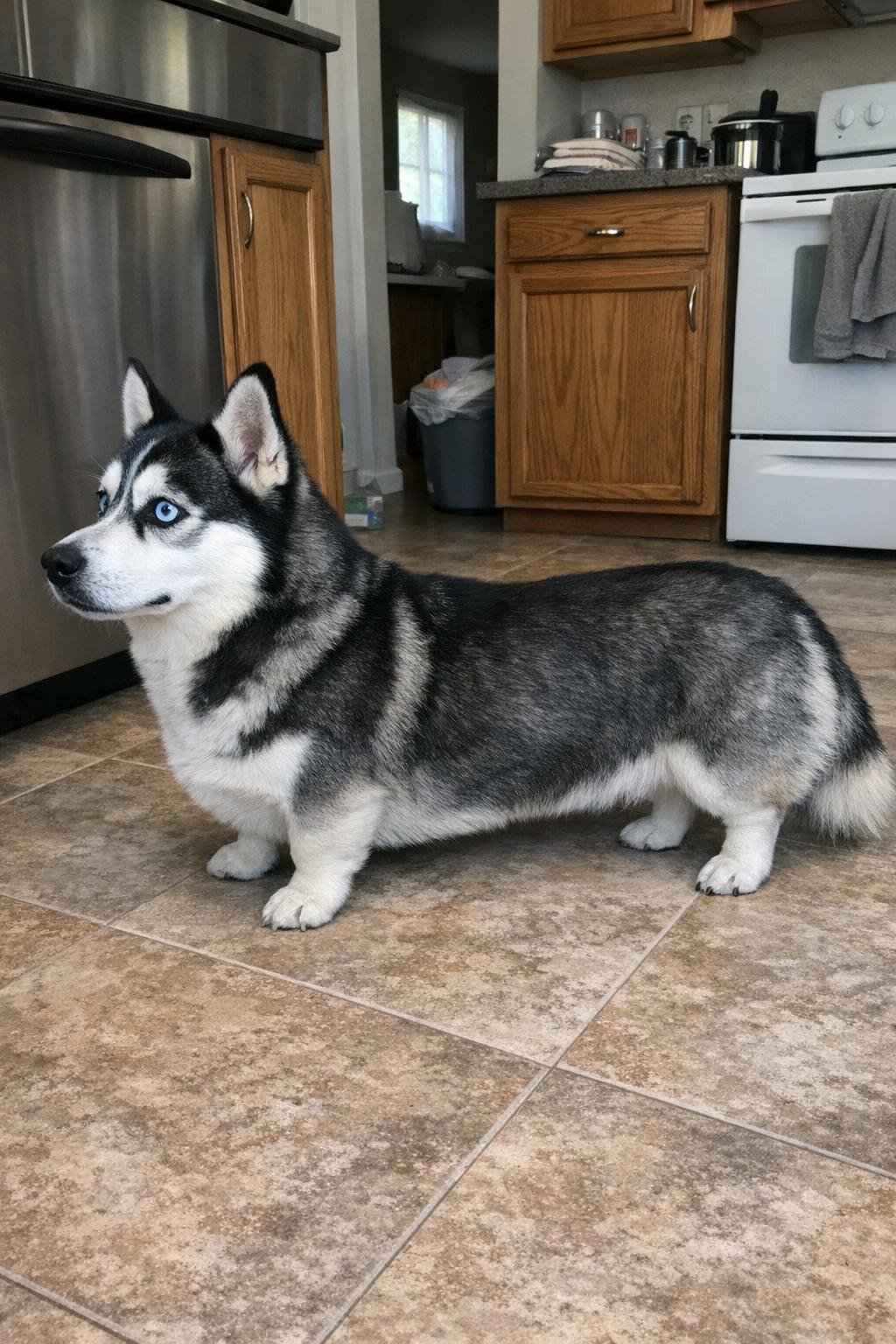
When my sister told me the shelter paperwork listed her new dog as a simple “Husky mix,” I pictured the usual possibilities: maybe some shepherd, maybe some lab, maybe one of those wonderfully impossible rescue combinations that only make sense after you’ve lived with the dog for a few weeks. Then she sent me one standing photo from her kitchen, and I laughed out loud in the middle of a work email because the front half said snow dog and the bottom half said, absolutely and without apology, something else entirely.
If you’ve ever looked at a rescue pup and played accidental canine detective, you already know how fun this is. The face, the coat, the eyes, the ears, the body length, the leg height—they all tell a story, and this little guy is telling two very different stories at once. My best guess, and honestly the guess that makes the most sense once you look at him nose to tail, is Siberian Husky mixed with Basset Hound. And before I walk through why, you need to meet the new kid.
See for yourself:
1. The face is giving full Husky
The first clue is the face shape. He has that classic Siberian Husky look: a wedge-shaped head, a fairly defined muzzle, and bright, alert expression. Huskies often have a balanced, fox-like face rather than a broad, blocky one, and that’s exactly what jumps out here first. If you covered up the body and just looked from the shoulders up, plenty of people would confidently call him a Husky.
The blue eyes really push that impression over the top. While blue eyes can show up in a few breeds, they are one of the most recognizable Husky traits. In rescue dogs, a pair of vivid icy or sky-blue eyes immediately makes people think northern breed, and in this case I think that instinct is right.
2. The body says Basset Hound almost immediately
Now for the part that makes this dog unforgettable: that very long, low body. Basset Hounds are famous for a body built close to the ground, with a stretched-out silhouette and noticeably short legs. This isn’t just “short for a Husky.” This is dramatically low-slung, the kind of proportions that make you do a double take.
A typical Siberian Husky stands roughly 20 to 23.5 inches at the shoulder, while a Basset Hound is usually much lower, often around 11 to 15 inches. A mix can land anywhere in between, but when you see a dog with a Husky’s facial features attached to a frame this low, Basset becomes one of the strongest candidates fast.
3. Those stubby legs are the biggest giveaway
Short legs in mixed-breed dogs can come from several breeds, but Basset Hounds are one of the most obvious sources because their dwarfing trait is so visually distinctive. The legs tend to look sturdy and abbreviated compared with the body, not just petite. That’s what I see here.
In practical terms, dogs built like this often move with a slightly rolling gait rather than the long, floating stride you’d expect from a Husky. My sister says he can hustle surprisingly fast across the kitchen when he hears a food wrapper, but his proportions still read much more Basset than anything athletic and leggy.
4. The ear situation is interesting
Basset Hounds are known for those famously long, velvet-soft ears that hang low past the jawline, while Huskies have upright triangular ears. In a mix, ears can go either way: fully upright, partially folded, or somewhere in the middle. That’s why ear shape alone isn’t enough to identify a dog, but it does help when combined with everything else.
If this dog’s ears sit a bit higher or look less dramatic than a pure Basset’s, that doesn’t rule Basset out at all. Mixed dogs are like shuffling a deck of traits. You might get the Husky face and eye color, the Basset body and legs, and an in-between ear set that makes him look even more one of a kind.
5. Coat and coloring can hide the hound half
One reason shelter labels can stay broad is that coat pattern tends to fool people. Huskies have those very recognizable facial masks, contrasting light and dark markings, and plush double coats. Basset Hounds, meanwhile, often come in combinations like tricolor, lemon and white, red and white, or black and white, with a much shorter coat texture.
In a Husky-Basset mix, you can get a dog whose coloring screams Husky while the structure tells a different story. That’s probably part of why “Husky mix” ended up on the paperwork. Shelter staff usually have minutes, not weeks, to assess a dog, and they go with the most visible breed signal first.
6. Why shelters often keep it vague
I always think it’s worth saying this: breed labels at shelters are often educated guesses, not guarantees. Staff may estimate based on appearance, behavior, size, and whatever history came with the dog, but unless there’s owner paperwork or a DNA test, nobody truly knows for sure. “Husky mix” is a safe, reasonable label when the dog clearly shows strong Husky traits.
And honestly, I get it. If a dog has a Husky face but Basset legs, there is no neat one-word answer for that intake form. Rescue dogs can also be mixes of mixes, so it’s possible there’s Husky, Basset Hound, and one more breed tucked in there too. But if we’re talking about the most likely “other half,” Basset Hound is the cleanest fit.
7. Personality clues may support the guess
Temperament won’t prove breed, but it can add to the picture. Huskies are often energetic, vocal, clever, and just a little theatrical. Basset Hounds tend to be stubborn, scent-driven, affectionate, and more laid-back indoors. Put those together and you may get a dog who is both dramatic and deeply committed to doing things on his own terms.
That combination feels very real to me. A Husky-Basset type dog could absolutely be the kind of pet who argues about bedtime, sings when excited, then parks himself on the coolest patch of kitchen tile and refuses to move. If your sister is already noticing a mix of independent streak and people-loving charm, that would fit this guess nicely.
8. Expect a funny mix of exercise needs
This is one of those mixes where looks and needs may not line up in an obvious way. Huskies are famously active and often need 60 to 90 minutes of exercise a day, plus mental stimulation. Basset Hounds usually need less intensity but still benefit from daily walks, scent games, and weight management.
For a Husky-Basset mix, I’d expect moderate daily movement to be important: maybe two walks of 20 to 30 minutes each, plus short play sessions and sniff-heavy enrichment. Because of the short legs and long back, I would avoid repetitive jumping off high furniture or pounding up and down long staircases all day. It’s a very cute build, but it can need some thoughtful management.
9. Back health matters with a long, low dog
Whenever I see a long-backed dog with short legs, I think immediately about spine protection. Basset Hounds can be prone to orthopedic issues, and dogs with elongated bodies can put more stress on the back over time, especially if they become overweight. Even 3 to 5 extra pounds can matter more on a low-to-the-ground frame than people realize.
If this were my dog, I’d keep him lean, use ramps where possible, and ask the vet for a target weight range. Depending on his size, that might be something like 35 to 50 pounds, but mixed breeds vary a lot. Regular nail trims every 3 to 5 weeks, supportive bedding, and controlled exercise can also make a big difference.
10. Grooming may be easier than people expect
With Husky in the mix, people hear “fur” and panic a little. Fair enough—Huskies are serious shedders, especially during seasonal coat blows that can seem to produce enough fluff to fill a throw pillow. But if the other parent is Basset Hound, the coat texture and density may land somewhere in the middle.
I’d plan on brushing 2 to 3 times a week, and probably daily during heavier shedding seasons in spring and fall. A slicker brush, undercoat rake if needed, and a rubber grooming mitt usually cover a lot of ground. If he inherited Basset-style ears, I’d also pay close attention to ear cleaning, because lower or heavier ears can trap moisture more easily.
11. Food motivation could be very real
Basset Hounds are often highly food motivated, and many Huskies are smart enough to use that to their advantage during training. That can actually be great news for a busy household. A dog who will happily work for pea-sized treats, kibble rewards, or tiny bits of freeze-dried salmon is much easier to teach than a dog who finds you boring.
The main thing is portion control. If he’s built low and long, extra weight can sneak up quickly. I’d measure meals with an actual measuring cup, not guesses, and factor treats into the daily total. For a medium-size dog, that often means keeping treats under about 10 percent of daily calories.
12. Training should balance consistency with humor
If this really is a Husky-Basset blend, I would go into training with a sense of humor and a plan. Huskies are smart but not always eager to obey just because you asked. Bassets can also be wonderfully stubborn. That doesn’t mean untrainable; it means you need short, clear sessions that feel worth the dog’s effort.
Think 5 to 8 minutes at a time, a few times a day. Work on recall, leash walking, wait at doors, and polite greetings early. Because both breeds can be distractible in different ways—Huskies by movement and excitement, Bassets by scents—I’d use a harness, a secure leash, and a fenced yard if possible.
13. A DNA test would be fun, but the visual case is already strong
I love a dog DNA reveal as much as anyone, and if your sister wants to spend the roughly $80 to $150 that many popular kits cost, it could be a fun project. It might confirm Husky and Basset Hound, or it might throw in a surprise like Corgi, Beagle, or Dachshund. Mixed-breed genetics love to humble us.
But purely from visual clues, this one feels less mysterious than most. The blue-eyed northern-breed face plus the extra-long body and very short legs is such a specific combination that Siberian Husky and Basset Hound rises to the top for me immediately.
14. My final guess: Husky plus Basset equals one ridiculously charming dog
If I had to put my money on it without a DNA test, I’d say the other half is Basset Hound. Not just “some kind of hound,” but specifically Basset, because the body proportions are doing so much of the talking. He looks like somebody set a Husky on low-rise mode, and I mean that with complete affection.
And honestly, that’s the joy of rescue dogs. They don’t always fit neatly into breed charts, but sometimes they walk into a kitchen, stand sideways for one photo, and tell you exactly who they are. This new kid looks like a Husky-Basset mix to me—and an adorable one at that.