
 Dogs
Dogs Cats
Cats Birds
Birds Horses
 On the Land
 In the Sea
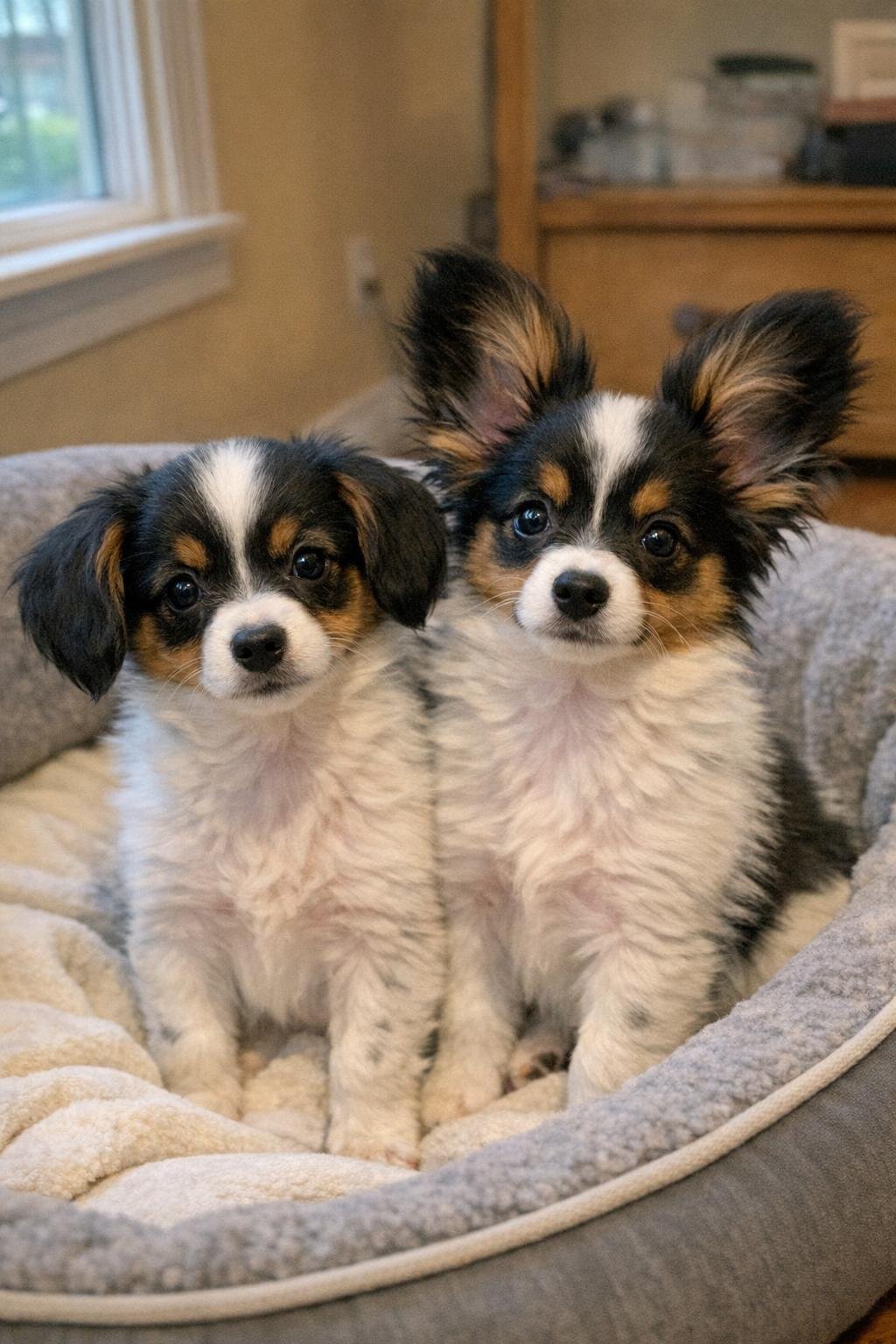
Last week our Papillon delivered four healthy puppies, and for the first few days I was doing what every slightly sleep-deprived breeder and dog person does: counting tiny bellies, checking weights twice a day, and staring far too long at each little face. Three of the pups looked exactly the way most people expect a young Papillon litter to start shaping up, even at this early stage. But the fourth stopped every visitor in their tracks. I’d lift the bedding, point to the box, and without fail somebody would say, “Wait — what’s going on with that one’s ears?”
If you know the breed, you probably already know why this caught my attention. Papillons are famous for those upright, fringed “butterfly” ears, but the breed also has a lesser-known drop-eared variety called the Phalène. Because this surprises so many people, I wanted to put together exactly what we’re seeing, why it can happen in the same litter, what is normal in early puppy ear development, and when floppy ears are simply a charming genetic throwback rather than a health problem. And yes, I’ll show you the puppy everyone keeps talking about.
Here she is:
1. What people are actually seeing in that last puppy
The puppy getting all the attention appears to be showing the drop-ear look associated with the Phalène variety of the Continental Toy Spaniel family. In simple terms, instead of the ears lifting up and out to the side in that classic butterfly shape, the ear leather falls downward, framing the face. In our litter, the contrast is especially obvious because one sibling already carries those more upright, open ears, so side-by-side the difference looks dramatic.
To non-dog people, it can look like one puppy is “wrong” and the others are “right.” That is not what this is. In this case, the most likely explanation is a recessive inherited trait, not an injury, not poor care, and not a sign that the puppy is unwell. The puppy is nursing well, gaining weight steadily, squeaking loudly when annoyed, and bulldozing siblings off the warmest spot in the bed, which is usually my first sign that all is perfectly normal.
2. Papillon and Phalène are more closely related than many owners realize
One reason this surprises people is that many pet owners think “Papillon” only means a toy dog with upright ears. Historically, though, the erect-eared Papillon and the drop-eared Phalène are two ear varieties within the same broader breed tradition. The Phalène name comes from the French word for “moth,” while Papillon means “butterfly,” which neatly describes the ear shapes.
Depending on the registry and country, both ear types may be recognized within the same breed framework or closely linked standards. So when a dropped-ear puppy turns up, it is not some mysterious cross appearing out of nowhere. It can be an old trait resurfacing because both parents quietly carried the genes for it.
3. How a recessive trait can appear in an otherwise typical litter
The easiest way to picture recessive inheritance is this: a puppy gets one copy of a gene from the mother and one from the father. If the dropped-ear Phalène trait behaves recessively, a puppy usually needs two copies of that version — one from each parent — for the trait to show clearly.
That means two Papillons with erect ears can still produce a dropped-ear puppy if both are carriers. In a simple recessive model, each puppy in the litter has roughly a 25% chance of inheriting two recessive copies, a 50% chance of being a carrier without showing it, and a 25% chance of inheriting no recessive copy at that location. Real-life genetics can be more nuanced than a textbook square, but as a practical explanation for owners, that 25-50-25 breakdown helps.
With a litter of four, getting one puppy that strongly suggests the recessive ear type is absolutely plausible. Four puppies is a small sample, not a mathematical guarantee. You could see zero, one, two, or even more pups leaning one way than expected just through ordinary genetic chance.
4. Why I’m cautious about making a final call too early
Puppy ears are notorious for changing as the weeks go by. In toy breeds especially, ears can look low one week, then perk, then wobble during teething, then settle again. Cartilage strength, head growth, coat weight, and development all play a role. So while this puppy is strongly suggesting a dropped-ear outcome, I still avoid declaring anything with 100% certainty in the first days of life.
In my routine, I check ears visually every day during normal handling, but I don’t manipulate them excessively. I note whether the base feels firm, whether both sides look symmetrical, and whether there’s any heat, swelling, discharge, or tenderness. A normal floppy presentation is soft and natural. A puppy with ear trauma or infection would usually show other signs, and that is not what we are seeing here.
5. What is normal for Papillon puppy ear development by age
At birth and in the first 1 to 2 weeks, most puppies have soft, undeveloped ear carriage. Their ears can look tiny, folded, and somewhat uninformative. Between about 3 and 6 weeks, you may start seeing more individual variation, but it can still be too early to know exactly where things will land.
By roughly 8 to 12 weeks, many breeders get a clearer sense of likely ear set, though even then there can be fluctuation. Teething, which often intensifies around 4 to 6 months, can temporarily affect ear carriage because the body is directing calcium and energy toward rapid growth. I’ve seen owners panic at 16 weeks over “failed ears,” only to message me again at 24 weeks saying everything changed.
That’s why photos taken every 7 days in the same position and lighting are far more helpful than memory. I keep a simple note with body weight in grams, nail trims, deworming dates, and ear observations. Over 6 to 10 weeks, a pattern becomes much easier to see than it does day to day.
6. How I tell “genetic dropped ears” from a problem that needs a vet
There are a few practical checkpoints I use. A genetically drop-eared puppy is usually otherwise completely normal: bright, warm, nursing or eating appropriately, active, and symmetrical in movement. The ears themselves look clean, evenly placed, and painless when the puppy is handled gently.
By contrast, I would call my veterinarian promptly if I saw one ear drooping while the other suddenly changed, especially after rough play or an accidental bump. I’d also worry about odor, redness, crusting, dark discharge, repeated scratching, head shaking, swelling, or crying when the ear is touched. In a newborn or very young puppy, any sign of infection, fever, poor feeding, or low weight gain matters much more than ear style.
Our little surprise puppy has none of those red flags. Weight gain has been steady, hydration is good, and the puppy’s behavior matches the others. That makes a benign inherited ear variation by far the most sensible explanation.
7. Why visitors react so strongly when they see the pair side by side
The gasp factor is honestly the comparison. If you see the dropped-ear puppy alone, you might just think, “What a sweet toy spaniel.” But when that puppy is sitting next to a sibling with those classic wide, lifted butterfly ears, the contrast is striking. One looks airy and winged; the other looks soft and rounded.
I think it also catches people because they assume purebred litters should look almost identical. In reality, littermates can vary in blaze width, body size, coat amount, tail carriage, bone, and expression even within a narrow weight range. In our litter, the smallest puppy was 142 grams on day one and the largest was 168 grams. Tiny differences add up quickly on a face as delicate as a Papillon’s.
8. Does a dropped-ear puppy mean the parents are not purebred?
Not necessarily, and in this case that would be the wrong conclusion to jump to. A recessive trait showing up does not automatically imply a cross. It can simply mean both parents carried genetic information that was not obvious in their own appearance.
This is one of those moments where knowing breed history matters. The Papillon and Phalène connection is not a random internet rumor; it is part of the breed’s longstanding story. If anything, a dropped-ear puppy can reflect old, legitimate inheritance rather than impurity. Of course, pedigree records and, where useful, DNA tools can help answer broader breeding questions, but ear carriage alone is not proof of mixed ancestry.
9. What this means for the puppy’s health and quality of life
For day-to-day living, a healthy dropped-ear puppy should do every normal puppy thing: eat, play, learn, snuggle, race around the kitchen at unsafe speeds, and steal socks with complete confidence. The ear style itself does not doom the puppy to discomfort.
There are, however, some practical care differences with drop ears in general. Ears that hang closer to the canal can trap a bit more warmth and moisture than open, upright ears. That doesn’t mean constant infections are inevitable; it just means I pay attention. I check weekly for smell, wax buildup, redness, or dampness, especially after baths or humid weather. A quick dry after bathing and avoiding unnecessary ear products goes a long way.
10. Whether breeders can predict or prevent this
Sometimes yes, sometimes not with certainty. If a breeder knows the family history well and has seen dropped ears appear before, they may suspect both parents are carriers. But unless the inheritance pattern is fully understood and documented in that line, prediction can still be imperfect.
Even with a strong pedigree, recessive traits are sneaky by nature because carriers do not always advertise themselves. A line can go several generations with no obvious dropped-ear puppies, then produce one when the right pair is combined. That is exactly why experienced breeders track not just what dogs look like, but what their siblings, parents, and offspring looked like too.
If someone is breeding specifically with show outcomes in mind, ear carriage becomes a more strategic consideration. If someone is breeding for healthy, sound companions with full honesty about possible outcomes, then a surprise like this is less of a crisis and more of a genetics lesson delivered in a very cute package.
11. What I’m watching over the next 8 to 12 weeks
Right now my checklist is boring in the best possible way. I’m tracking daily weight for the earliest period, then every few days once gains are consistent. I want to see a steady upward trend, warm body temperature, good muscle tone, strong suckling, and age-appropriate development like opening eyes, stronger walking, and normal social responses.
For the ears specifically, I’m watching whether both ears remain evenly dropped, whether the set changes as the skull broadens, and whether the puppy develops the softer, elegant frame around the face that people associate with the Phalène look. I’ll take weekly photos from the front and both sides from about 2 feet away so proportions are easier to compare honestly.
By the 10- to 12-week mark, I’ll have a much clearer idea of whether this is a true lasting dropped-ear presentation or an early-stage ear carriage that may still evolve. Until then, I’m enjoying the suspense more than stressing over it.
12. If you’ve seen this in your own litter, you are not alone
This is probably the main reason I wanted to write this. When something unusual appears in a litter, the internet can make owners feel either foolish for asking or frightened for no reason. But a Papillon-type puppy showing dropped ears is not unheard of, and in the context of breed history, it is very much a known possibility.
If you’ve had one appear, the smartest next steps are simple: document the puppy with clear photos, keep good health records, speak to your veterinarian if anything seems medically off, and ask knowledgeable breed people who understand the Papillon-Phalène relationship rather than just general dog gossip. In many cases, what you have is not a problem to fix at all — just a lovely little reminder that genes have long memories.
13. My honest reaction as the person standing over the whelping box
I’ll admit it: my first response was not scientific elegance. It was me squinting into the box at 6 in the morning with a cup of tea gone cold, saying, “Well, aren’t you interesting?” After that came the practical checks — weight, latch, warmth, vigor, symmetry — because health always comes first. Once all of that looked solid, I let myself appreciate how special this puppy is.
And that’s where I’ve landed. Not alarmed. Not embarrassed. Just fascinated. If this little one continues to develop as a Phalène-style puppy, then we’ll have a perfect real-life example of a recessive trait showing itself in a modern Papillon litter. For dog lovers, that’s the sort of surprise that keeps breeding history from feeling abstract. It’s right there in the dog bed, blinking back at you.