
 Dogs
Dogs Cats
Cats Birds
Birds Horses
 On the Land
 In the Sea
When my sister told me the shelter had listed her new dog as a “Dalmatian mix,” I pictured a leggy, athletic youngster with a sleek outline and maybe a few mystery features around the face. Then she sent me a quick phone photo from her living room, and I laughed out loud in the best possible way. The spots were absolutely there, but so was a long, low little body and a pair of bright ears that looked ready to catch every crinkle of a treat bag from 20 feet away.
As someone who has spent years cooking by instinct and studying ingredients by origin, I have the same habit with dogs: I like to look at structure, proportions, and the clues hidden in plain sight. Shelter labels are often educated guesses, especially with mixed breeds, so half the fun is noticing what really stands out once the dog settles into a home. In this case, the answer felt almost immediate. See for yourself:
Here she is:
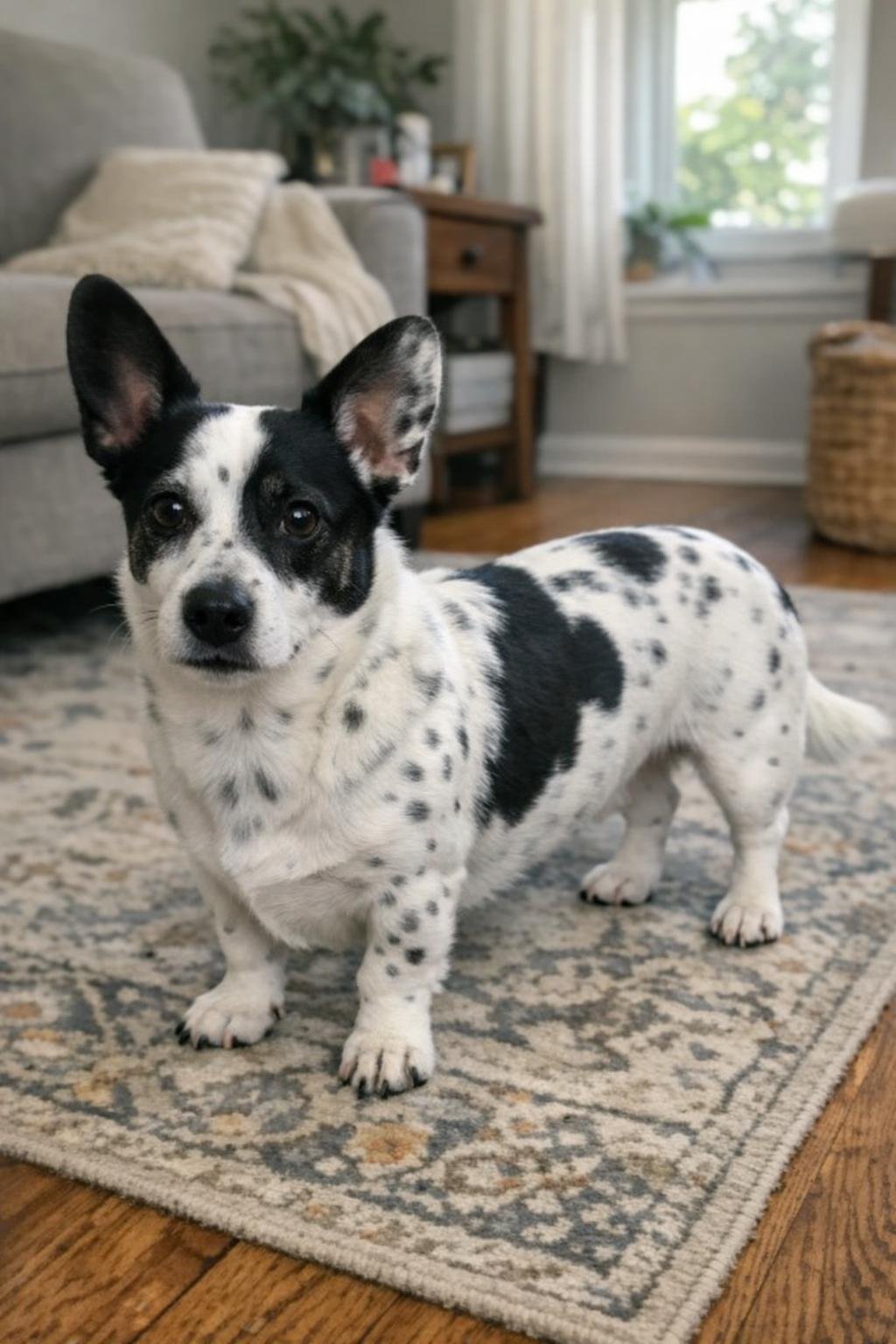
1. My guess: there is very likely corgi in this mix
If you asked me on the spot what the “other half” is, I would say corgi before I finished my coffee. The biggest giveaway is proportion. A Dalmatian has long legs, a fairly square athletic frame, and a deep but balanced chest. This dog, by contrast, has the classic low-slung silhouette many of us associate with a corgi: close to the ground, slightly elongated through the body, and visibly shorter in the leg.
The upright ears also support that guess. Dalmatians usually carry drop ears that frame the face. Perked, triangular ears standing high are far more in line with corgi structure. Add the white coat with distinct black spotting, and a Dalmatian-corgi mix becomes a very believable explanation.
2. The body shape is the strongest clue
When I look at mixed-breed dogs, I try to ignore color for a moment and focus first on architecture. If a dog’s back appears noticeably longer than its height at the shoulder, and the legs look shortened relative to the torso, that often points to a breed carrying dwarfing genes, sometimes called chondrodysplasia. Corgis are one of the best-known examples.
In practical terms, a pure Dalmatian commonly stands around 19 to 24 inches at the shoulder. A Pembroke Welsh Corgi is often closer to 10 to 12 inches. A mix can land anywhere in between, but when you see a dog that looks “long and low” rather than “up on stilts,” that corgi influence becomes hard to miss.
3. Those ears are doing a lot of detective work
Ears tell you more than people realize. In the kitchen, I say you can tell a lot about a dish before tasting it just by aroma and texture; with dogs, ears are a bit like that first aroma. They are one of the quickest signals of lineage.
Corgis tend to have erect, pointed ears that are proportionately large for their heads. Dalmatians have softer, rounded drop ears. A mix may land in the middle, but if the ears are clearly upright and alert, that shifts the odds strongly toward a corgi-type parent. In this case, the perked ears are one of the first things that jump off the image.
4. The coat pattern says Dalmatian, but pattern alone never tells the whole story
The black-on-white spotting is what likely got the shelter to write “Dalmatian mix,” and that part makes perfect sense. Dalmatians are famous for their sharply defined spots, usually black or liver, on a white coat. If even part of that pattern carries through strongly, it can dominate first impressions.
But coat pattern can be misleading when used alone. Plenty of mixed dogs have piebald, ticking, patches, or spots that suggest one breed more loudly than their body shape does. In this dog’s case, the pattern says Dalmatian, while the build says corgi. Put those two clues together, and the theory becomes much more convincing than either clue would be by itself.
5. Why shelters often make their best guess
I always think it is worth saying gently: shelter breed labels are often approximations, not guarantees. Staff may have only a few minutes with a dog at intake, no parental history, and a hundred other responsibilities that day. If a pup is white with black spots, “Dalmatian mix” is a perfectly understandable first label.
Studies on visual breed identification have shown that even experienced animal professionals can be wrong, especially with mixed breeds. Once a dog gets into a calm home, new traits become obvious: gait, ear carriage, body proportion, vocal habits, and even herding tendencies. That is often when the “aha” moment happens.
6. A Dalmatian-corgi mix can inherit an interesting energy profile
This combination is charming, but it would not surprise me if it also came with a lively engine. Dalmatians are energetic sporting dogs developed to run alongside carriages over distance. Corgis, though compact, are sturdy herding dogs bred to move livestock and stay mentally engaged.
That can mean a mix who needs more exercise than her small height suggests. I would expect many dogs of this type to do well with 45 to 75 minutes of activity per day, split into manageable pieces: perhaps a 25-minute morning walk, 15 minutes of fetch or tug, and a shorter evening outing. Add puzzle feeders or a snuffle mat, and you may save your shoes and table legs.
7. Temperament may be affectionate, bright, and a little opinionated
Corgis often come with a big personality packed into a low frame. Dalmatians can be devoted, clever, and alert. Together, that may produce a dog who is affectionate with family, observant about every movement in the house, and fully prepared to offer commentary when dinner is 12 minutes late.
My sister’s type of dog, if this guess is right, may bond quickly and follow people from room to room like a tiny spotted supervisor. That can be delightful, but it is also a reminder to work on calm independence. A few short sessions of mat training, 5 to 8 minutes at a time, can help a dog learn to settle instead of constantly monitoring the household.
8. The health considerations are worth knowing early
With any mix, I like to think in terms of informed watchfulness rather than worry. Dalmatians are known for a predisposition to urinary stone issues because of how they process uric acid. Corgis, especially as long-backed dogs, can be more vulnerable to orthopedic strain and spinal issues if they become overweight or repeatedly jump off furniture.
That means this sort of dog benefits from good hydration, regular veterinary care, and careful weight management. If the dog should weigh, say, 28 pounds in ideal condition, carrying an extra 4 or 5 pounds is not trivial; on a short-legged frame, that is a lot of additional stress. Ramps to sofas, controlled stair use, and keeping the waist visible from above are all practical steps.
9. Feeding a long, low dog takes a bit of discipline
This is where my food-brain always kicks in. People tend to overestimate how much a compact dog needs because those eager eyes are persuasive. A medium-small active mixed breed might do well on roughly 1.25 to 2 cups of a balanced kibble per day, depending on calorie density, age, and activity level, but the exact amount should come from the bag’s calorie information and the veterinarian’s guidance.
Treats add up quickly. Two training treats here, a biscuit there, a scrap of cheese while you are making omelets, and suddenly you have added 100 to 200 calories to a small dog’s day. For many dogs under 30 pounds, that is significant. I like using tiny rewards the size of a pea, or even part of the daily kibble ration, for training.
10. Grooming may be easier than you think, but shedding is still likely
A short coat tricks people into assuming low maintenance. In reality, both Dalmatians and corgis can shed quite a bit, though in different ways. Dalmatian hair is short and can work its way into upholstery like little needles. Corgis are heavier shedders with a dense double coat.
A mix may need brushing 2 to 4 times per week to keep loose hair under control. A rubber curry brush or grooming mitt often works well on short coats, and a slicker or undercoat tool may help if the dog inherited more corgi texture. Baths every 4 to 8 weeks are usually plenty unless the dog rolls in something truly memorable, which, in my experience, dogs treat as a personal accomplishment.
11. Training should start with the basics and a sense of humor
If there is corgi in this dog, I would not be surprised by intelligence paired with selective hearing. That is not stubbornness in a moral sense; it is often just a bright dog deciding whether your idea competes successfully with the squirrel outside the window.
Start with name recognition, recall, loose-leash walking, and polite greetings. Keep sessions short, around 3 to 7 minutes, and repeat them 2 or 3 times a day. Reward quickly and consistently. If there is a herding streak, watch for ankle-nipping with excited movement, especially around children. Redirect early with toys, structured games, and clear interruption before the behavior becomes a habit.
12. If you want to know for sure, a DNA test can be fun and surprisingly useful
Visual guessing is entertaining, and sometimes we get very close, but a reputable canine DNA test is the only practical way to move beyond speculation. Most kits cost somewhere between $80 and $160 depending on the company and whether health screening is included. You swab the dog’s cheek, mail it in, and usually get results in 2 to 6 weeks.
Beyond satisfying curiosity, results can help owners discuss likely breed tendencies and some inherited health concerns with their veterinarian. I would still treat DNA as one tool rather than destiny, but it is certainly more reliable than ten relatives squinting at one photo over group text.
13. The charm of this mix is exactly in the contradiction
What makes a Dalmatian-corgi mix so irresistible is the visual surprise. Spots suggest elegance and speed. The low body suggests comic confidence and practicality. Together, they create a dog who looks as if someone took a carriage dog and gently pressed the “compact” setting.
I love dogs like this because they remind us that mixed breeds do not read our expectations. They turn up with the coloring of one ancestor, the ears of another, and the proportions of a third possibility we had not even considered. The result is often much more memorable than a textbook silhouette.
14. My final answer
If I were placing a friendly bet from that description and reveal photo alone, I would say the other half is corgi, or at the very least a strong corgi-type influence. The short legs, long body, and upright ears line up too neatly to ignore, while the white coat with black spots keeps the Dalmatian side front and center.
And honestly, “Dalmatian-corgi mix” feels exactly right for the new kid: spotted, low to the ground, alert, and impossible not to smile at. If my sister’s household is anything like most Midwestern homes I know, that dog will be running the living room in about 72 hours and the hearts of everyone in it much sooner than that.