
 Dogs
Dogs Cats
Cats Birds
Birds Horses
 On the Land
 In the Sea
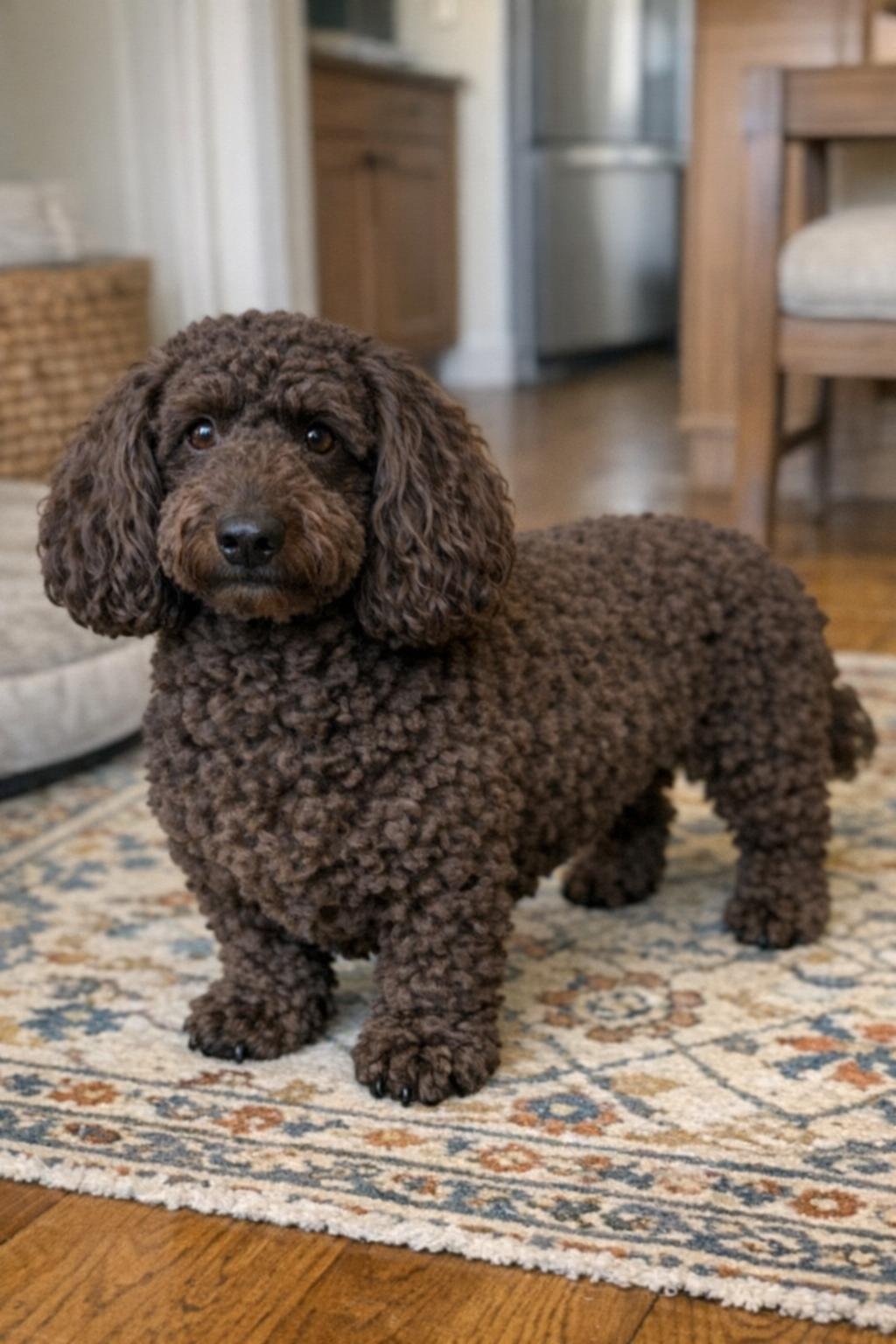
I’ve lived long enough to know that shelter labels are usually a best guess, and “Basset Hound mix” can mean just about anything once a dog actually walks through the front door and settles onto the living room rug. My neighbor’s new rescue proved that point in about 30 seconds. From a distance, I saw the unmistakable low-slung, elongated Basset build and those soft, pendulous ears. Then the dog turned, the light hit that dense coat, and I laughed out loud. This was no plain hound cross. This little fellow looked as if someone had taken a classic Basset outline and wrapped it in a full layer of tight, dark poodle curls.
If you enjoy guessing breeds from body shape, coat texture, ear set, and movement, this is exactly the kind of dog that will send you down a rabbit hole. I spent a good while watching him trot across the rug, sniff the baseboards, and lean into every friendly hand within reach, and the answer felt more obvious by the minute: this “Basset Hound mix” very likely has Poodle in him. And once you start looking closely, the clues are everywhere.
See for yourself:
1. The first clue is the coat
A pure Basset Hound typically has a short, smooth coat that lies close to the body. What jumped out immediately here was the exact opposite: tight, springy curls over the entire frame, especially dense over the torso, neck, and legs. That kind of coat texture is one of the biggest tells of Poodle influence.
Curly coats like this often grow continuously rather than shedding out in the straightforward way a Basset coat does. If this dog is indeed a Basset-Poodle mix, regular brushing 3 to 4 times a week and professional grooming every 6 to 8 weeks would not surprise me at all. A shelter may spot “Basset” from the shape, but the coat is doing a lot of the talking here.
2. The body says Basset almost immediately
Even under all that curl, the silhouette is classic low rider. The body appears longer than tall, with a deep chest and notably short legs. That’s very much in Basset territory. Most Basset Hounds stand around 11 to 15 inches at the shoulder, and mixes often keep that low profile even when another breed changes the coat, muzzle, or tail.
That long-back, short-leg structure is often what makes people stop and stare. On a curly-coated dog, it becomes even more striking because the eye expects a doodle shape and instead gets something much closer to a hound on compact legs.
3. Those ears are another major hint
Long, floppy ears are one of the most charming Basset features, and this dog appears to have kept them in full. Poodles can have dropped ears too, but they usually don’t carry the same long, heavy, hound-like look. When you pair very long ears with a low, stretched body, the Basset half becomes hard to miss.
Ear care matters a lot in a mix like this. Long ears reduce airflow, and curly hair around the ear opening can trap moisture. In practical terms, that may mean ear checks every week, gentle cleaning when advised by a veterinarian, and extra attention after baths or rainy walks.
4. Why “Bassetoodle” is the guess I’d make
If I had to put money on it from appearance alone, I’d say Basset Hound crossed with Poodle, often nicknamed a “Bassetoodle” or “Bassetdoodle.” It’s not one of the most common doodle combinations, which is part of why it looks so surprising at first glance. But the blend actually makes visual sense once you break it down: hound frame, poodle coat, and a face that can land anywhere in between.
Depending on whether the Poodle parent was miniature or standard, adult size can vary quite a bit. Many of these mixes seem to land somewhere in roughly the 25- to 45-pound range, though some may be lighter or heavier. The shorter leg structure can also make the dog look stockier than the scale suggests.
5. The face often settles the debate
One of the best places to look in a suspected mix is the muzzle and eye area. Basset Hounds tend to have a softer, heavier expression, often with looser skin and a slightly mournful look. Poodles usually bring a more refined muzzle and a brighter, alert expression. In a mix, you can get a middle ground: a houndy face with tighter curls framing it.
That contrast is part of what makes these dogs so endearing. You get the soulful gaze of a scent hound paired with the plush, teddy-bear presentation of a curly-coated breed. It’s the sort of combination that makes strangers ask, “What on earth is he?” on nearly every walk.
6. Movement can reveal breed traits too
I always like to watch a mixed-breed dog move before guessing. Bassets have a deliberate, grounded gait, with a bit of roll through the body because of their build. Poodles often move with more spring and lift. A Basset-Poodle mix may trot low to the ground but still show a lighter, bouncier step than a pure Basset.
That matters beyond breed curiosity. Structure affects exercise needs and joint care. A dog built low and long usually does best with moderate daily activity rather than repeated high-impact jumping off furniture or pounding through obstacle courses. Think two or three walks totaling 45 to 60 minutes a day, plus nose games indoors.
7. Temperament is where the pairing gets really interesting
Basset Hounds are famously scent-driven, stubborn, affectionate, and often very funny without trying to be. Poodles tend to be highly trainable, observant, and mentally quick. Put those together and you can get a dog who is smart enough to learn fast and opinionated enough to decide whether your idea is worth following.
That combination can be delightful in a home. You might see a dog who learns “sit” in 10 minutes but takes 3 extra days to agree that coming inside is more important than following an intriguing smell near the fence. In my experience, those are often the dogs with the biggest personalities.
8. Grooming would be far more involved than the shelter label suggests
If someone heard only “Basset Hound mix,” they might picture a fairly simple coat. A Poodle cross changes that entirely. Tight curls can mat at the armpits, behind the ears, under the collar, and around the tail base in as little as a few days if the dog gets damp or rubs around the house a lot.
A realistic care routine might include a slicker brush, a metal comb, and 10 to 15 minutes of line brushing several times per week. Grooming appointments can easily run every month and a half to two months, and depending on region, cost might range from about $60 to $120 or more. That’s a meaningful part of ownership for a dog like this.
9. Health-wise, both sides bring things to watch
With a Basset-type body, I’d think about back stress, elbow and shoulder loading, and the general wear that comes with a long spine on short legs. With Poodle in the mix, I’d also keep an eye on skin, ears, and coat maintenance. Neither breed guess can tell you everything, of course, but structure and coat together offer good practical clues.
Weight control becomes especially important in a low-bodied dog. Even an extra 5 pounds can put noticeable added strain on joints and the back. For many dogs of this shape, keeping them lean is one of the kindest long-term health decisions an owner can make.
10. A DNA test would be fun, but the visual evidence is strong
I’m always the first to admit that visual breed guesses can be wrong. Mixed dogs have a way of humbling even confident observers. Still, some cases offer stronger hints than others. Here, the combination of long hound ears, elongated body, short sturdy legs, and all-over poodle curls makes the Poodle theory feel more than plausible.
If my neighbor ever sends off a DNA test, I’d be curious to see percentages. I wouldn’t be shocked by a result that came back with a majority Basset and a significant Poodle share, perhaps with one more breed tucked in at 10 to 20 percent. Shelter dogs often carry a few surprises.
11. Why this kind of mix wins people over so fast
There’s something irresistible about a dog who looks assembled from two very different sketches. The Basset contributes comic proportions and a sweet, easy charm. The Poodle contributes texture, elegance, and often a little extra social brightness. The result is memorable in the best way.
I’ve noticed that unusual-looking rescues tend to become neighborhood celebrities almost instantly. People remember them. Kids point them out. Other dog owners ask questions. Before long, the dog isn’t just “the new one from the shelter.” He’s the curly Basset-looking fellow everyone hopes to see on the evening walk.
12. Living with a Basset-Poodle mix would mean balancing nose, brain, and body
If this dog really is what he appears to be, the sweet spot for care is balance. He’d likely benefit from mental work such as snuffle mats, treat puzzles, short training sessions of 5 to 8 minutes, and scent games that let him use that hound brain. At the same time, his body shape suggests avoiding too many stairs, repeated leaps off beds, or slippery floors without rugs.
That home rug in the photo is actually a detail I like seeing. For low, heavy little dogs, traction matters. Hardwood can turn a short hallway into a skating rink. A few washable runners, a supportive bed, and a set of steps to the couch can make daily life easier and safer.
13. My final answer: I’d bet on Poodle
If you asked me on the spot, “What’s the other half?” my answer would be Poodle without much hesitation. Not because shelters are wrong about the Basset side, but because the curly coat changes the whole read of the dog once you notice it. The hound is in the outline. The Poodle is in the covering.
And honestly, that’s part of the joy of rescue dogs. They don’t always arrive with perfect paperwork or tidy breed labels. Sometimes they show up as a marvelous little question mark with floppy ears, short legs, and a coat nobody saw coming. In this case, I think the mystery leans strongly toward one very curly answer.